

How much can you save with the Windfall Battery?
Up to £250 per year! But, what does up to mean? Good question! The answer is a bit complicated, so let's break it down.
Your electricity bill will have two components to it:
The standing charge - a fixed amount you pay every day.
A usage charge - an amount you pay for each 'unit' of electricity that you consume. That is what your meter is measuring.
Typically, the usage charge is a fixed value, perhaps 26p per kWh of electricity (one 'unit').
But that's not how your energy supplier buys energy. The wholesale energy price varies throughout the day depending on how much is being used and how much is being generated. When renewables are abundant, energy prices are cheap and vice versa. When lots of people are using energy and we're using lots of gas, energy prices are expensive.
Your energy supplier averages that all out and gives you a fixed price per kilowatt hour, but you can get access to tariffs that allow you to have different pricing at different times of the day, sometimes called Economy 7 or peak or off-peak pricing.
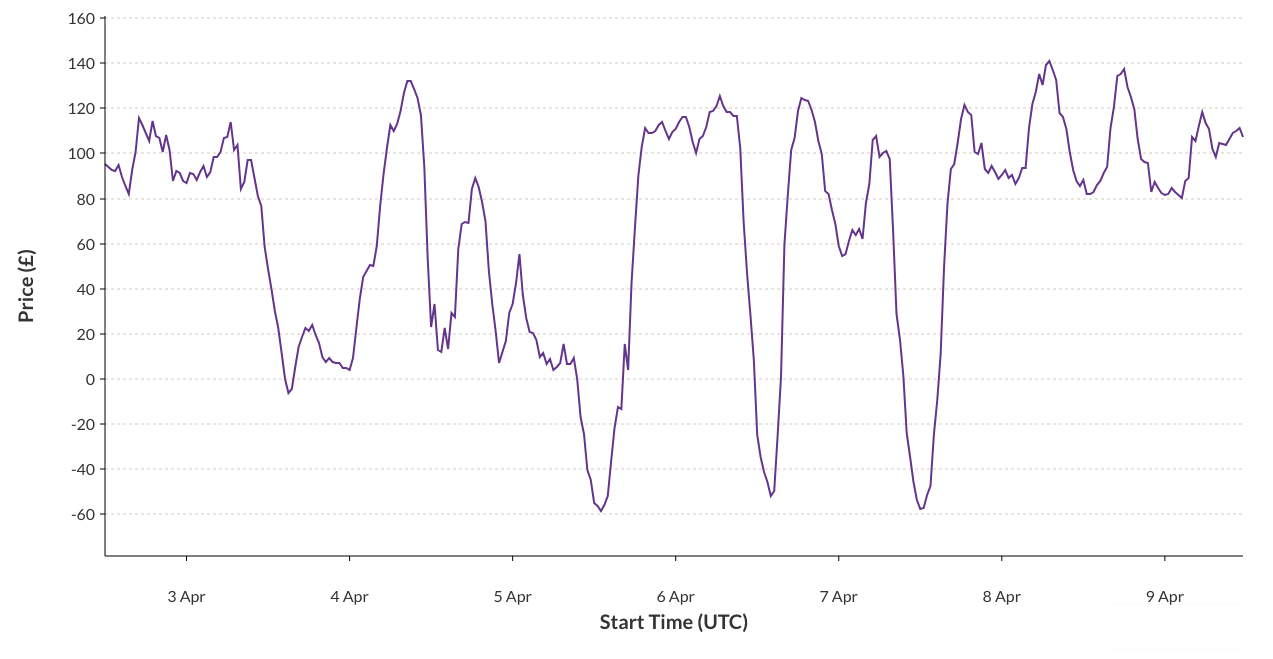
Wholesale electricity price over a week (GBP per MWh)¹
When you're on one of those tariffs, you might have a peak price of 40p per kWh and an off-peak overnight price of 15p. Meaning that if you can store energy from when it's priced at 15p and use it when energy would normally cost 40p, you can save 25p per kilowatt hour that you stored.
So to get savings from a Windfall Battery, you need to be on a tariff with two or more prices.
Let's do some maths on typical tariffs. As an example let's first start with an Economy 7 tariff from Octopus Energy. In London the peak price is 32.32p and the off-peak price is 12.94p. For the Windfall Battery we can store 2.5 kWh of energy per day. Doing the maths on this:
2.5 kWh x (£0.3232 - £0.1294) p/kWh x 365 = £176.84So, a potential saving of over £175 per year.
Some tariffs have a bigger delta, in exchange for shorter off-peak windows. e.g.:
Octopus Flux
Peak: 0.3574p
Off-peak: 0.1534p
£186 per year savings
Octopus Intelligent Go
Peak: 33.72p
Off-peak: 8p
£228 per year savings
British Gas Home Battery Tariff
Peak: 37.275p
Off-peak: 18.638p
£170 per year savings
E.ON Next Smart Saver
Peak: 38.48p
Off-peak: 16.33
£202 per year savings
Scottish Power EV Saver
Peak: 35.78
Off-peak: 5.99
£272 per year savings
There is a little more complexity to it than this though. We have to account for efficiencies of the battery, times when you're not using much energy and not fully utilising the battery, and other various factors.
Given that, we can safely assume that we can save around £150 a year from the battery by charging up and then using cheap off-peak energy.
Savings beyond the tariff
There is a second area where savings come from, often called Grid Flex.
Think about what happens at 6 PM in the UK. Millions of people get home at the same time, turn up the heating, start the oven, and put a load of washing on. This creates a massive "peak load" that puts the national grid under huge strain. You can see that spike represented as a price increase in the wholesale price graph above.
Because our grid is quite old, it often hits its capacity during these hours. The wires simply can't move enough energy to keep up with everyone's dinner plans and chores. To fix this, grid operators would rather pay you to use less energy than spend billions digging up roads to lay new cables.
The Windfall Battery handles this for you. It uses its stored overnight energy to power your home during that 6 PM rush, meaning you aren't pulling power from the grid when it's struggling.
We’re currently working to finalise the details of these "flex" rewards alongside some of the largest energy suppliers, and grid operators in the UK. We expect this to add roughly £100 per year to your savings, bringing your total potential benefit up to, or even over that £250 mark.
Can I increase my savings even more?
Yes, if you want to save even more there are options. Once you're on a tariff with different prices in the day time and the night time, the more you use at night the more you save. You could try:
Moving your dishwasher to run overnight
Or doing the same with your washing machine
Taking your storage heater and programming it to run at even cheaper times
There are lots of things you can do to maximise the benefit of this new tariff. In the savings above we've only counted the savings delivered by your Windfall Battery.
Here's a challenge: think about what else you can run at off-peak times. The more usage you move to off-peak, the more you can save. Here are a few ideas:
A dishwasher ran every other day could save £36 per year by moving from peak to off-peak
Heated clothes airers once a week might be £18 savings a year
A medium-sized electric storage heater can be up to £450 per year!
We wrote another blog on this; check it out here.
Save £250 a year
Some marketing campaigns use phrases like “up to 100% effective”, which can sound rather meaningless. Here we’ve shown you our working, and that £250 is realistically achievable. And that it could even be more!
As always please get in touch if you have any further questions.
And if you want to be one of the first people to get a Windfall Battery, check out our pre-order offer here:
¹ https://bmrs.elexon.co.uk/market-index-prices
Not that all the prices quoted here were correct at the time of writing.
